
Blue whale (Balaenoptera musculus) sightings off the coast of Virginia.
Marine Biodiversity Records. 2020.
13:6. https://doi.org/10.1186/s41200-020-00189-y
More details
Collapse details
Date Published:
Publication:Ocean:Region:Species:Methods:
- May 27, 2020
We report on two sightings of individual blue whales (Balaenoptera musculus) off the coast of Virginia during marine mammal surveys. On 11 April 2018, during a vessel survey off the coast of Virginia, a single blue whale was observed approximately 100 km east-northeast of Virginia Beach. On 10 February 2019, another single blue whale was recorded during an aerial survey approximately 135 km east-southeast of Virginia Beach
Complete
Small vessel visual surveys in the Mariana Islands Range Complex
Project Objectives
Identify species of beaked whales, odontocetes, and baleen whales that occur in the Mariana Islands; Monitor marine mammal and sea turtle presence, distribution, and diversity in nearshore waters during key seasons (summer and winter); Develop a better understanding of marine mammal distribution, movement patterns, habitat use, population structure, and abundance; Develop reference library of visually-validated acoustic recordings of marine mammals.
Current
Visual Survey and Tagging of Hawaiian Odontocetes
Project Objectives
(1) define the spatial movement and habitat use patterns of species that are exposed to mid-frequency active (MFA) sonar (2) determine how these patterns influence exposure and potential responses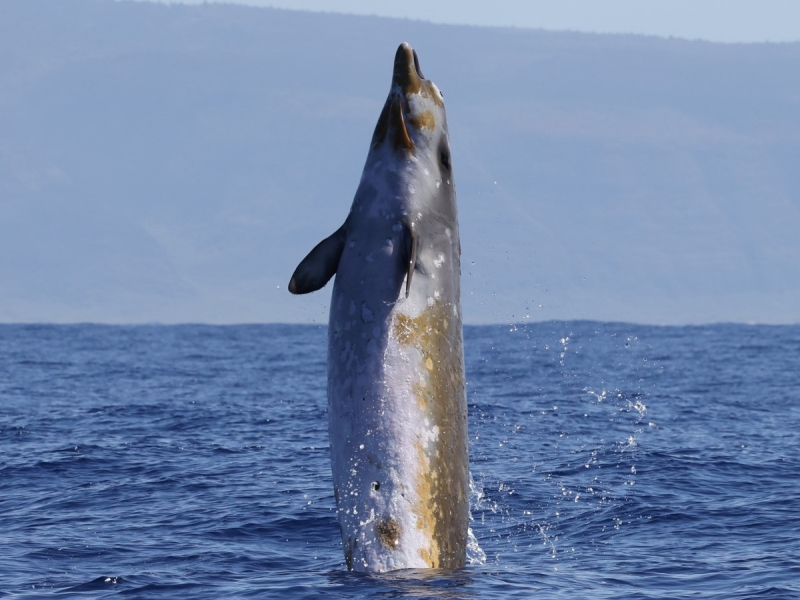
Kaua'i Field Work Updates
February 20, 2025
Scientists from Cascadia Research Collective recently completed a ~9-day field project off Kaua’i that started on February 9th. This project is timed to occur prior to a Submarine Command Course (SCC) training event. The primary goal is to deploy satellite telemetry tags on multiple species of odontocete cetaceans prior to the SCC, to be able to examine their behavior before, during, and after the event. This approach has been very successful in the past as a way of examining how different species respond to Navy training activities including mid-frequency active sonar (MFAS). Click through the picture below to see daily updates.